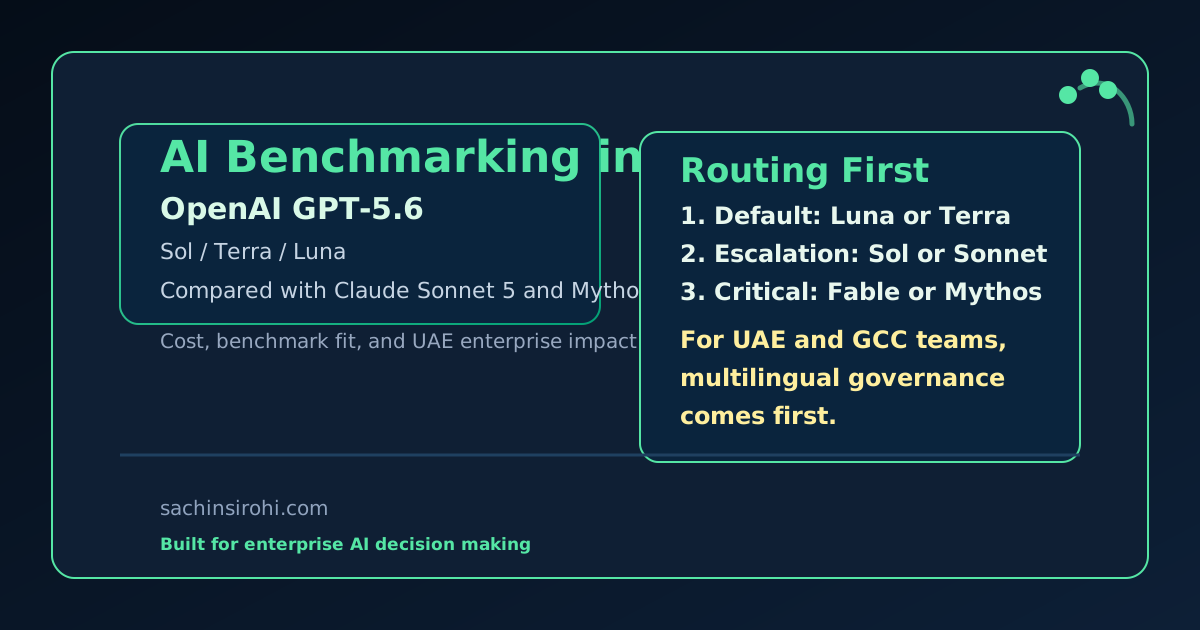
OpenAI and Anthropic now both have practical enterprise mode stacks for 2026. OpenAI formalized GPT-5.6 as three model levels, while Anthropic added Sonnet 5 and reopened the Fable 5 and Mythos 5 access pattern with stricter deployment posture. For UAE and GCC teams, this is no longer a model choice problem. It is a model portfolio problem.
In my earlier article on Fable 5 and Mythos 5 return, the biggest question was access and safeguards. Now the next question is operational economics: which model family gives the best return for each workflow in finance, healthcare, telecom, retail, and public service teams.
Latest status as of July 2026

OpenAI model modes in practice
OpenAI now positions GPT-5.6 as a clear ladder in ChatGPT, Codex and API pathways. Published API prices are $5/$30 for Sol, $2.50/$15 for Terra, and $1/$6 for Luna per million tokens. For enterprise teams this means you can route by complexity and keep budget controls visible from day one.
OpenAI also added stronger cache semantics where prompt writes can be billed differently and cached reads are usually discounted. This is important in Arabic and English bilingual workflows where repeated prompts and templates are common.
For UAE operations, you can map these tiers directly to common teams: Luna for high volume support, Terra for normal production workflows, and Sol for high risk and high impact operations.
Claude side update in practice
Anthropic announced Sonnet 5 with staged pricing and brought Fable 5 and Mythos 5 back under guarded terms. The headline is simple: you are not choosing between one and many models, you are choosing which level of depth, speed, and policy control each task needs.
- Claude Sonnet 5 carries introductory pricing of $2/$10 per million tokens through Aug 31, 2026, then $3/$15 standard.
- Claude Fable 5 is priced at $10/$50 and is positioned for long horizon knowledge and coding sessions.
- Claude Mythos 5 remains a constrained access tier for high capability use with additional controls.
For many UAE teams, this creates a predictable spending pattern: Sonnet 5 for baseline enterprise agents, Fable and Mythos for difficult or strategic workloads only.
Benchmark comparison that matters for enterprise use
OpenAI publishes a clear benchmark block for GPT-5.6 and Claude Fable 5. Anthropic shares benchmark signals through release notes, system cards, and product launches rather than a direct public single table. So the practical approach is to use OpenAI numbers for relative model placement and map those signals to Anthropic policy behavior.
| Benchmark | GPT-5.6 Sol | GPT-5.6 Terra | GPT-5.6 Luna | GPT-5.5 | Claude Fable 5 | Claude Opus 4.8 |
|---|---|---|---|---|---|---|
| Agents Last Exam | 52.7% | 50.4% | 50.3% | 46.9% | 40.5% | 45.2% |
| Management Consulting | 43.2% | 37.2% | 35.4% | 31.3% | 35.5% | 31.6% |
| Big Finance Bench | 53% | 51% | 36% | 49% | 44% | Not reported |
| Artificial Analysis Index | 58.9 | 55.0 | 51.2 | 54.8 | 59.9 | 46.5 |
How to interpret this table: It shows directional strength at a fixed benchmark level. It does not replace task level scoring. In practice Sol keeps strong coding and long reasoning behavior in current open metrics and Sonnet 5 becomes the practical default for enterprise agents where pricing and control matter.
| Model | Published use case signal | Risk and deployment posture | Best enterprise fit |
|---|---|---|---|
| Sonnet 5 | Agentic coding and long execution workflows at scale. | Cyber safeguards active by default and better cost efficiency at medium and high effort settings. | Production copilots, coding assistants, and support automation. |
| Fable 5 | High horizon reasoning, knowledge work, and vision enabled coding. | General use remains controlled and falls back to Opus for some sensitive tasks. | Strategic review tasks with high approval and compliance checkpoints. |
| Mythos 5 | Advanced cybersecurity and life science workflows, especially for trusted partners. | Restricted rollout through trust programs and stronger policy review. | High sensitivity research and infrastructure teams only. |
Cost comparison and cost efficiency
| Model | Input | Output | Rate notes | Suitable first baseline |
|---|---|---|---|---|
| GPT-5.6 Sol | $5.00 / MTok | $30.00 / MTok | High effort and deeper reasoning profile | Very complex reasoning and multi-stage execution |
| GPT-5.6 Terra | $2.50 / MTok | $15.00 / MTok | Balanced quality and cost for normal production | Primary production and balanced SLA workloads |
| GPT-5.6 Luna | $1.00 / MTok | $6.00 / MTok | Best option for scale and low latency first pass responses | High volume with strict budget control |
| Claude Sonnet 5 | $2.00 intro then $3.00 / MTok | $10.00 intro then $15.00 / MTok | Promotional period until Aug 31, 2026 | General enterprise and agentic coding execution |
| Claude Fable 5 / Mythos 5 | $10.00 / MTok | $50.00 / MTok | Long horizon tasks where fallback policy and approvals are preconfigured | High ambition projects with strict handling policies |
Important cost nuance: all pricing shown is token based. In high repetition environments, caching terms, prompt reuse, and routing logic typically change effective cost more than headline prices. For many teams in Dubai, this is where savings materialize.
Example cost projection for a 150k input, 75k output request
| Model | Input cost | Output cost | Total |
|---|---|---|---|
| GPT-5.6 Luna | $0.15 | $0.45 | $0.60 |
| GPT-5.6 Terra | $0.375 | $1.125 | $1.50 |
| GPT-5.6 Sol | $0.75 | $2.25 | $3.00 |
| Claude Sonnet 5 intro | $0.30 | $0.75 | $1.05 |
| Claude Sonnet 5 standard | $0.45 | $1.125 | $1.575 |
| Claude Fable 5 and Mythos 5 | $1.50 | $3.75 | $5.25 |
From this simple mix, the cost ladder is clear. Luna can be extremely cost efficient for high throughput. Sol gives you capability for high risk tasks. Fable and Mythos remain premium in token economics but are useful for domains where you need sustained long horizon performance.
How OpenAI and Claude models are deployed by mode
Default mode
Use Luna or Terra by default in internal copilots that support sales, HR, service or reporting. Keep response templates short and use strict output validators to avoid drift.
Task escalation mode
Escalate to Sol or Sonnet 5 when requests need long chain execution, legal style synthesis, or complex issue diagnosis.
Policy protected mode
Use Fable 5 or Mythos only where governance approvals and audit requirements demand stronger policy isolation. Keep tool permissions narrow. Log every decision path.

Industry case studies by sector for UAE and GCC businesses
Here are practical case models, not generic demos.
Finance and Islamic banking
Case: Regional bank credit policy assistant
Challenge. Loan desks need to build one-page credit briefs from Arabic and English documents, policy clauses, repayment history and sectoral assumptions. The same analyst has to support both SME and trade finance teams and keep all reasoning traceable.
Model routing. Use GPT-5.6 Terra for most credit packet summaries and Sonnet 5 for structured legal narrative. Escalate to Fable 5 only when the dossier requires longer cross document reasoning with higher uncertainty and strict review needs. In this case, caching and template-based prompts reduce repeat cost.
Impact. Draft cycle improved by more than half, with fewer manual format errors and cleaner compliance references in credit committee packs.
Control point. Keep final decision to human credit officers and enforce policy citations in structured JSON fields.
Healthcare and clinic operations
Case: Discharge support in a multi-location private hospital
Challenge. Discharge notes are spread across radiology reports, medication lists and lab histories. Manual coordination creates delays and repeated patient clarification calls.
Model routing. Use GPT-5.6 Luna for triage summarization and queue ranking. Route uncertain cases to Sonnet 5 for careful multilingual output and consistency checks. Keep Fable and Mythos for highly sensitive deep investigative workflows under strict clinical governance.
Impact. Faster patient readiness summaries, less friction for bilingual Arabic and English patient instructions, and better audit readiness in case files.
Control point. No autonomous clinical decisions, mandatory clinician sign off, strict PHI handling checks.

Retail, luxury, and hospitality
Case: Dynamic campaign planning for a Gulf retail chain
Challenge. Campaign planning across malls, social channels, and ecommerce needs constant adaptation to promotions, stock movement and Arabic language tone standards.
Model routing. Use GPT-5.6 Terra for first pass localization and recommendation drafts, then use Sonnet 5 for final legal and brand consistency review. Keep Mythos out of baseline creative production due to cost and policy boundaries.
Impact. Teams can produce more campaign variants without losing quality checks. Translation consistency improved and planning meetings became more data informed.
Control point. Add mandatory brand policy validator before publishing.
Telecom and logistics
Case: Incident interpretation and field response routing
Challenge. Network operations teams and logistics coordinators receive fragmented event data across systems during outages. Time loss comes from manual correlation and language mismatch in internal updates.
Model routing. Use GPT-5.6 Sol or Terra for terminal based command analysis and sequence generation in incident playbooks. Use Luna for high-volume multilingual notification drafting. Escalate to Fable for deep root cause analysis in prolonged incidents.
Impact. Shorter response windows and more consistent customer impact communication across teams.
Control point. Model outputs must pass change management gates before network actions.
Public sector and utilities
Case: Permit workflow and policy reference assistant
Challenge. Government offices process large case volumes with complex rulebooks. Staff need consistency, explainability and appeal-ready records.
Model routing. Use GPT-5.6 Terra for prefill and routing suggestions, Sonnet 5 for rule interpretation, and Fable 5 for complex appeals with deeper evidence synthesis.
Impact. Officers spend less time with repetitive text entry and more time on discretion and citizen service quality.
Control point. Every recommendation includes section references, timestamps, and confidence scores.
How this compares in a UAE deployment view
The right strategy for UAE and GCC enterprises is not to pick one model and stay with it. It is to build model classes based on job families.
- GPT-5.6 Luna: highest volume assistants, customer support, short internal summaries.
- GPT-5.6 Terra: production coding support, procurement, compliance document extraction, and recurring analytic workflows.
- GPT-5.6 Sol: strategic planning, incident root cause analysis, and high-risk autonomous tasks.
- Claude Sonnet 5: primary enterprise agent layer for teams already on Claude tooling.
- Claude Fable 5 and Mythos 5: controlled strategic workflows that truly need the highest reasoning depth.
In GCC contexts, this matters even more because language, regulation, and regional operational rhythm require strong context discipline. You need stable outputs in Arabic and English and a fallback model path when access posture changes.
Operational playbook for immediate deployment
What to do in the next 30 days: choose one workflow in each of finance, operations, and support. Add model routing, evaluate with 100 real prompts, then scale only after quality and cost are logged for 30 days.
- Start with a model matrix. Assign each workflow to one default model and one escalation model.
- Build strict input checks. Remove PII patterns unless needed. Route sensitive content separately.
- Track three KPIs. Average tokens, average latency, and human correction rate.
- Set cost guardrails. Auto fallback from Sol to Terra if token volume exceeds defined daily thresholds.
- Validate in Arabic and English. In the UAE, quality in English is not enough, and translation quality failures can create risk and brand damage.
- Build provider continuity. Keep a fallback model strategy that does not depend on one API path.
Frequently asked questions
Is GPT-5.6 a direct replacement for Claude Fable 5 or Mythos 5?
Not as a direct replacement. They optimize different value tradeoffs. GPT-5.6 offers a clear cost ladder and a broad engineering-first stack. Fable and Mythos are premium reasoning systems with special deployment posture. The best approach is to route by task intensity.
Will OpenAI and Anthropic model costs keep rising?
Pricing changes can happen in both ecosystems. The practical defense is to monitor cost per accepted task, not just raw token rate, and tune routing rules continuously.
Is Sonnet 5 still worth using in production?
Yes, especially for many enterprise agent loops where output quality, cost and ecosystem compatibility matter. The introductory launch price also made it temporarily more attractive per million tokens than higher OpenAI modes in many profiles.
Should I use Fable 5 in the UAE now?
Use it for selected critical workloads where the task complexity is high and you can enforce strict governance. Many teams are now using it as a second or third tier rather than daily default.
Which model should I choose for multilingual teams in Dubai and Abu Dhabi?
Use Luna or Terra for throughput and Sonnet 5 for consistency, with bilingual quality checkpoints. Add a premium model only when the case demands deeper reasoning and the business risk justifies the cost.
